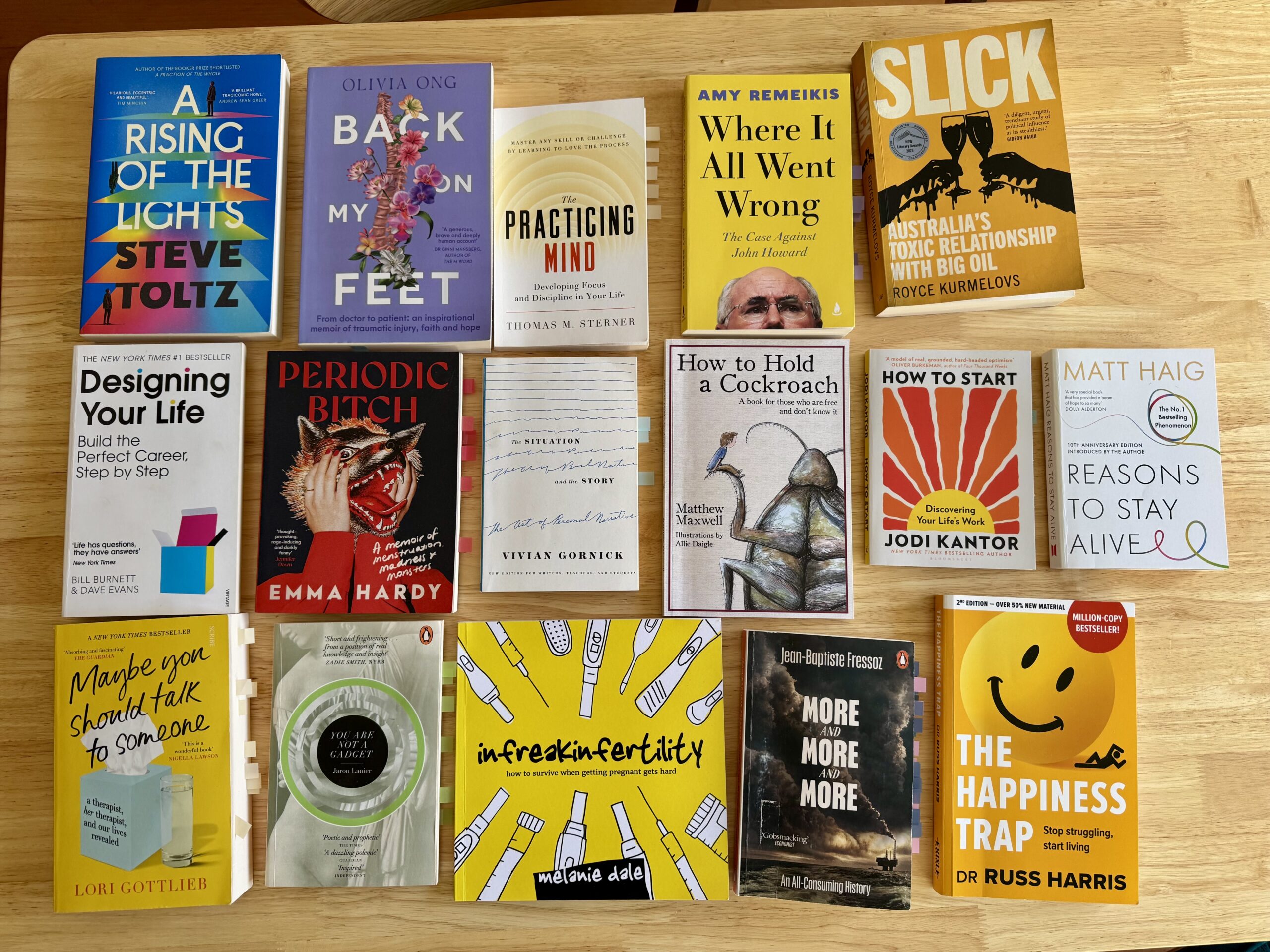

Between work, university, and undergoing surgery, I’ve been a little busy. Here are the books I’ve been reading and a brief sentence on each. As you’ll see, I went quite deep into a self-help/therapy rabbit hole, but you know what? I’m not mad about it.
Physical books
- A Rising of the Lights, by Steve Toltz — kind of funny, but a bit too dark and detached; was hoping for something a little warmer (more like Andrew Sean Greer’s ‘Less’)
- Back on my Feet, by Olivia Ong — Ong has an incredible story to tell, but she should not have been the one to tell it. This book was terribly written, and I blame the publishers for not stepping in more.
- The Happiness Trap, by Dr Russ Harris — simple but honestly radically transformative. Much better, for me anyway, than CBT (or therapy)
- You Are Not a Gadget, by Jaron Lanier — prophetic, scary, quite beautiful; not entirely sure what to do with it when it feels harder and harder not to be made into a gadget
- Maybe You Should Talk to Someone, by Lori Gottlieb — incredible. How have I not read this book yet? I wish Gottlieb was my therapist, but really, she was born to write. “I already know I’m going to love it,” said my mum, two pages in.
- Reasons to Stay Alive, by Matt Haig — if you can sense a theme across some of these books, I was going through it over the last few months. This one was pretty good — sad, heavy, tender. I’m glad to see a man opening up about this experience. I’m also glad to have never experienced anything like it. (Really put my own brief sadness into perspective.)
- Periodic Bitch, by Emma Hardy — affirming (Hardy and I share a common affliction), but quite repetitive on many levels; definitely missing something more substantial.
- Designing Your Life, by Bill Burnett and Dave Evans — I’ve already recommended this book to so many people. Fantastic advice; goes well with So Good They Can’t Ignore You and Cal Newport’s general advice on lifestyle planning.
- The Practicing Mind, by Thomas M. Sterner — a beautiful read after discovering Alysa Liu (late to the party, I know), and becoming addicted to her energy and outlook. This book passed the vibe check. I’d recommend it to anyone working on a skill or hobby.
- The Untethered Soul, by Michael Alan Singer — oops, forgot to include this one. Not a typical read for me as a decidedly unspiritual person, but this came up alongside The Practicing Mind and I was in the mood for ways to exist in the world without letting it consume me entirely. After pushing through some early woo-woo, I actually ended up finding this book quite practical and revelatory. Like The Happiness Trap and The Practicing Mind, I’m using these concepts daily.
- How to Start, by Jodi Kantor — I listened to Kantor on Kara Swisher’s podcast and had hoped this little book would offer something a little more concrete on navigating work in the age of AI, but alas, I don’t think anyone has the answers there. It was a nice little dose of motivation, but nothing particularly substantive there.
- How to Hold a Cockroach, by Matthew Maxwell — a classic cautionary tale for not listening to the algorithm’s recommendation. This book has followed me around Amazon for the better part of a year, and I finally relented. It was, predictably, terrible, but at least it’s gone from my recommended items now.
- Infreakinfertility, by Melanie Dale — I was worried this would be a little too Jesus-y, but it wasn’t too bad. It was actually quite funny and affirming; my partner and I both laughed at some of the passages and illustrations. I welcome anything funny about this very much un-funny journey we’re on.
- The Situation and the Story, by Vivian Gornick — short and to the point and immediately useful for personal essay writing. I had felt like something was missing in my personal essay ideas, and with this simple framing, Gornick has helped me identify what it is.
- Where it All Went Wrong, by Amy Remeikis — saw Remeikis at a launch event for this book. I hadn’t even intended to read it, just because my TBR is so long, but after laughing so much at the launch event, I felt I needed a pick-me-up. Remeikis is impressively concise and always funny. This was a fun, if not infuriating, read.
- Slick, by Royce Kurmelovs — much like his contemporary Remeikis, Kurmelovs is hilarious and has a particular knack for pointing out the hypocrisy and hilarity of the people who make up the oil industry. This book is painstakingly researched but a breeze to read.
- More and More and More, by Jean-Baptiste Fressoz — the biggest paradigm shift I’ve had from a book this year. Fressoz’s basic premise is that the ‘energy transition’ is a lie: not that the energy mix isn’t changing (it is), but that substituting one energy source for another has never happened before and is not happening now. Instead, as new sources of energy come into the mix, existing sources simply grow alongside them.
Kobo
- Welcome to Your New Life, by Anna Goldsworthy — after reading the latest Quarterly Essay by Anna Goldsworthy, I needed more. This beautiful and hilarious little memoir about pregnancy and motherhood had me laughing so often that even my partner remarked that I must be reading something special.
- The Correspondent, by Virginia Evans — read this for book club. Didn’t love it, didn’t hate it. It played out quite nicely, but I wasn’t quite as impressed with the letter format as many of my fellow book club goers seemed to be. It’s not a particularly original format.
Audiobooks
- Muskism: A Guide for the Perplexed, by Quinn Slobodian and Ben Tarnoff — I read this book right as the trillion-dollar news broke, and it truly delivered the goods. It breaks down Musk’s very odd collection of worldviews and how he acquired them. These are the philosophies behind the companies he built and the way he built them, but much of Musk’s thinking has also shaped American and global politics in a huge way.
- Sirens: Inside the Shadow World of First Responders, by Martin McKenzie-Murray — a fascinating, inspiring, and depressing look at the life of emergency workers. McKenzie-Murray does a wonderful job at incorporating his own insight while letting the subjects speak for themselves.
- Joyful, Anyway, by Kate Bowler — Bowler is a fantastic narrator; I’m glad I read this book this way. Was it helpful? A little. The best bits are by far Bowler’s own bizarre life stories. Might have been better as a memoir.
- Yesteryear, by Caro Claire Burke — this one absolutely lives up to the hype. This may be the best novel I’ve read all year.
- This is Going to Hurt: Secret Diaries of a Junior Doctor, by Adam Kay — I laughed out loud so often that I got strange looks from other dog-walkers. What a masterpiece.
- Born A Crime: Stories from a South African Childhood, by Trevor Noah — ummm… I can’t understand how one person’s childhood can be so full of unbelievable stories, but I’m also very suspicious of how all of Noah’s childhood ‘accidents’ (house burning down, friend’s eardrum pierced, friend arrested for shoplifting) are reported almost as if they are mysteries (how did that happen!?). Fascinatingly entertaining, and Noah’s impressions are off-the-charts good, but a little concerning nonetheless.
- London Falling, by Patrick Radden Keefe — classic example of creative non-fiction done well. I was spellbound, though I wish the resolution had been a little more satisfying.