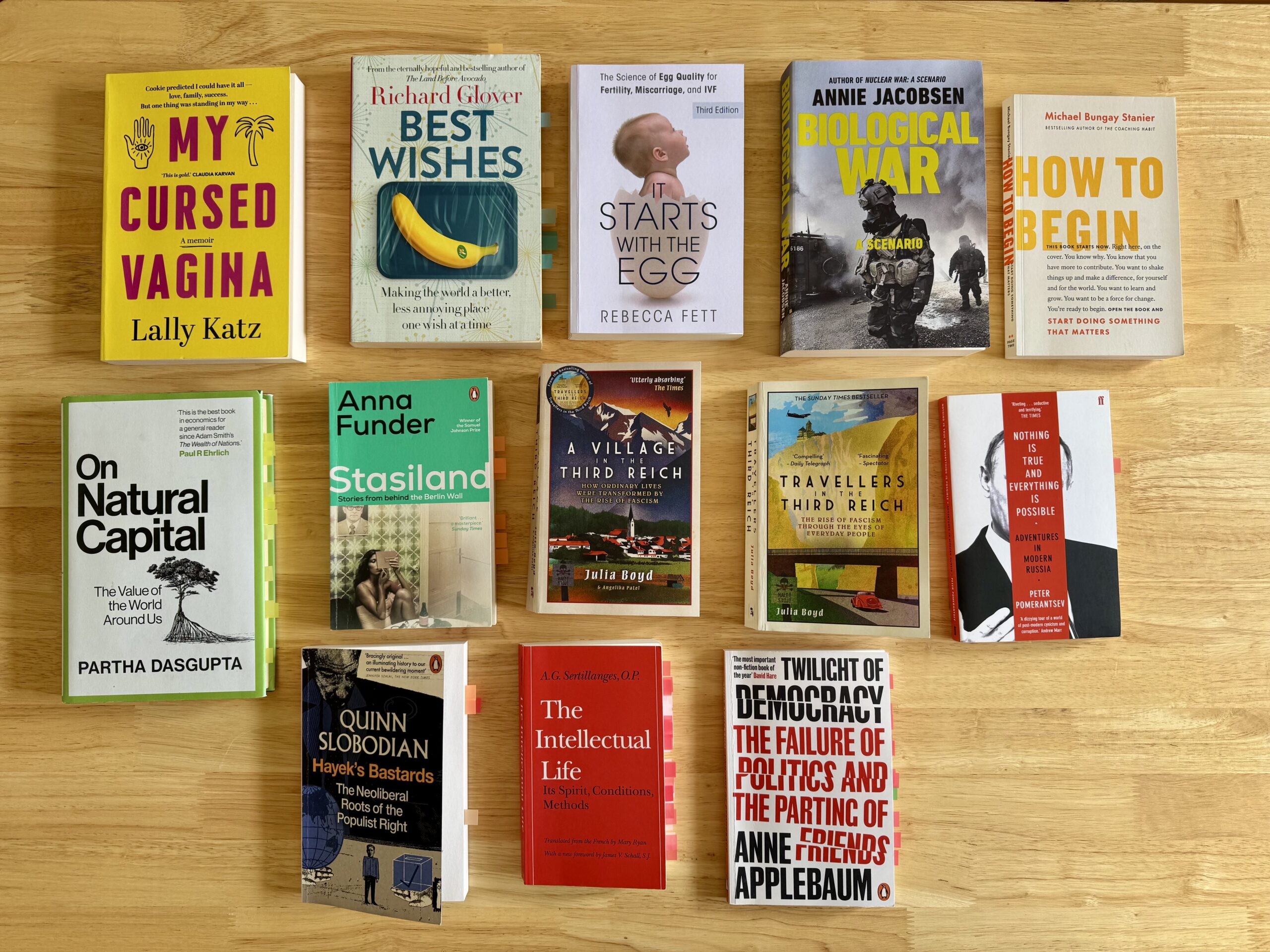

I’ve found so many good books lately that I’ve had no time to write about them. Here is a brief commentary on my recent reads:
- My Cursed Vagina — funny in parts but mostly just frustrating; I don’t love memoirs by women who portray themselves as one-sided hopeless hot messes. We all have our messy sides, but I’m sure there’s more to Katz than this disparaging memoir lets on.
- Best Wishes — Glover is at his best telling personal stories that combine the absurd with the tender. There’s a bit of that in here, but I longed for more.
- It Starts with the Egg — came highly recommended and was just the sort of practical book I like to read on this subject: strikes a solid middle ground between standard medical advice and evidence-based alternative approaches.
- Biological War — I loved listening to Nuclear War a few years ago, so much so that I didn’t notice how poorly it was written. Reading Biological War in print, I realised just how TikTokified Jacobsen’s prose really is. The historical snapshots were fascinating, but the hammed-up urgency and endless sentence fragments really ruined this book for me. I’d love more on this topic, but at an adult-grade reading level.
- How to Begin — I don’t know, I’m seeking inspiration at the moment. This book was better than I expected, but ultimately not terribly different from your average self-help book. I still haven’t begun, so to speak, but maybe that’s a me problem.
- On Natural Capital — some helpful frameworks in here; nothing terribly novel for someone who works in climate change and is studying environmental management. I appreciated Dasgupta’s description of his ideal reader: “I imagine her to be someone not so much interested in the Review [a government report] as in wanting to know how to structure her thinking about problems that worry her.” I am this reader, and I too would like to write for her.
- Stasiland — Funder is such a clean, sophisticated, restrained writer; this book is a joy to read. But more than that, it paints a complex and emotional portrait of East Germany under communist rule. As the progressive world searches for a new economic model, reading history is more important than ever.
- Travellers in the Third Reich — wow! Best book I’ve read in a long time. Sets out to answer the question: “What did travellers to Nazi Germany think of it?” Reaches the conclusion: People saw in Nazi Germany what they wanted to see. Some were appalled at the political oppression and treatment of Jews and minorities. Others thought this a small price to pay to get a country back on its feet. Some saw Hitler’s obsession with militarism as an inevitable road to war; others were somehow convinced that Hitler was devoted to peace. It is interesting that we think of two people reading the same facts in entirely different ways as a modern problem. It is not. I am suddenly gripped by WWII fervour; my TBR is now filled with the kind of history books that are apparently being branded ‘Dad books’.
- A Village in the Third Reich — picked this up after flying through Travellers. Very similar, not quite as psychologically fascinating, but still an incredibly enriching read. Focuses on a single village in the south of Germany and its experience after the First World War and before and during the second.
- Nothing is True and Everything is Possible — fascinating diagnosis of modern Russia (albeit pre-Ukraine war; I’d love an updated version) and how its transition from communism to rapid oligarchic wealth turned its government into a joke, its people into chameleons and reality into fiction.
- The Intellectual Life — if you can get past the Jesus talk and the astounding sexism anytime the word ‘wife’ is mentioned, then this is kind of a fun book for a bookish, writerly soul like myself. It’s not particularly prescriptive, but it does provide reassurance around just how much meaningful intellectual work can get done in only a few hours a day, and does caution against ‘excessive’ reading (including of novels, which are dangerous, ha), claiming that it confuses the mind. I have to admit, he has a point.
- Twilight of Democracy — very interesting book to read at the same time as Slobodian’s Hayek’s Bastards. I am more politically aligned with Slobodian than Applebaum, but Applebaum’s diagnosis of the modern alt-right carries weight precisely because of her membership in the conservative class. Having watched the right splinter in two over the last two decades, Applebaum has sharp insight into how and why this cohort diverged as it did (and, naturally, the consequences we’re now facing).
- Hayek’s Bastards — I don’t know enough about individual schools of economic thought to give this book the context it needs and deserves, but even with my limited and informal knowledge of economics and politics, this book takes a fascinating look at the lumping together of racial “science” and economics, and how the modern alt-right, in all its permutations, emerged from early neoliberal economics.
- The Reverse Centaur’s Guide to Life After AI — this short and funny book is a must-read for anyone thinking about AI and the workplace. Doctorow’s basic premise is that a tool like AI becomes either an enabler or an enshittifier based on how it’s used. When people are given the freedom to use AI as they find most useful, they typically report efficiencies and breakthroughs. When employees are forced to use AI, as is happening increasingly in larger organisations (i.e. when the use of AI becomes the target), stupidity reigns.
- From Miniskirt to Hijab: A Girl in Revolutionary Iran — not the most eloquent of titles, but this memoir really delivered on its promise. The author’s experience as a half-English, half-Iranian Jewish girl growing up in Tehran during the Iran revolution offers the kind of snapshot and intimacy your average history book can’t rival.
- Wormhole: My journey into the dark heart of alternative medicine — as someone who has stood at the edge of the wormhole myself, and seen numerous people fall into it, I thought the author did masterful job at exploring the psychology behind why so many people are today seeking medical help outside of the mainstream establishment. At times it felt like I was being lectured by all strains of progressive thought (to which I subscribe, so that might tell you how excessive it became), but overall this was still an interesting read.
Leave a Reply